

Designation: Reconstruction Protocol 7.1
Objective: To leverage Earth-based reality capture technology (UAS and TLS) to rapidly survey, model, and verify the reconstruction of critical Cybertronian infrastructure.
Lead Strategists: Ultra Magnus (Logistics), Shockwave (Science/Data Integrity), Bumblebee (Field Operations).
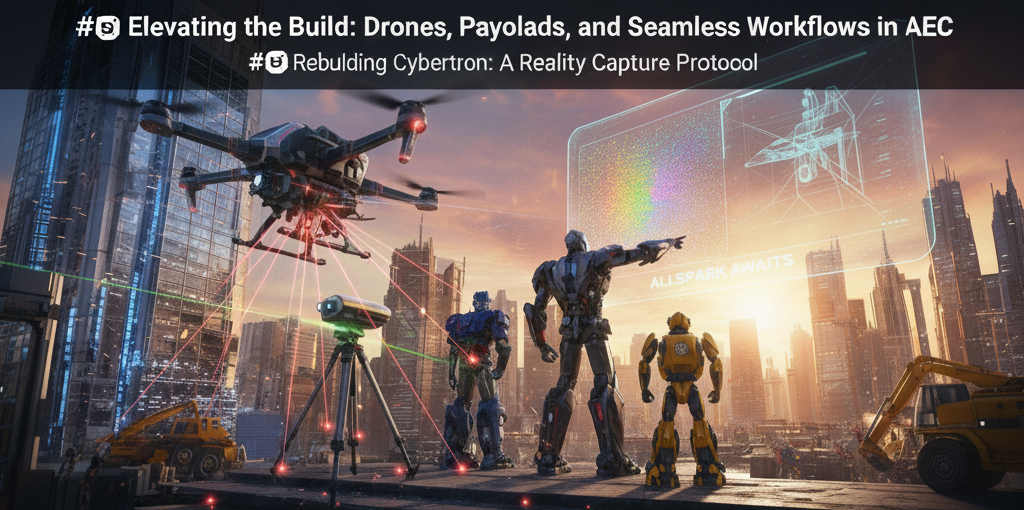
🛠️ Cybertronian Reality Capture Hardware: Strategic Deployment
Our first task is to select and deploy specialized sensor units—the payloads—with optimal flight/scanning platforms—the drones and scanners—to maximize data acquisition speed and accuracy across war-torn sectors.
Aerial Reconnaissance Unit 1: The Versatile Vanguard (DJI Matrice 300 RTK Class)
| Cybertronian Designation | Earth Equivalent | Primary Function | Strategic Advantage | Drawback |
| Sky-Surveyor Class UAV | DJI Matrice 300 RTK | High-Endurance Aerial Platform | Versatility: Can swap multiple sensor modules (Thermal, Zoom, LiDAR). Precision: RTK/PPK accuracy ensures ground coordinates align with Cybertronian grid systems ($C_x, C_y, C_z$). | Slower for massive regional mapping; high energy consumption requires frequent recharge cycles. |
| Recommended Deployment | Large General Contractors (Ultra Magnus’s Wreckers) and Surveying/Engineering teams requiring daily, versatile site monitoring and complex payload capacity. |
Ground Capture Unit 1: Millimeter-Grade Integrity (Trimble X9 Class)
| Cybertronian Designation | Earth Equivalent | Primary Function | Strategic Advantage | Drawback |
| Structure-Scanner TLS | Trimble X9 | High-Density Terrestrial Laser Scanner | Integrity: Millimeter-level precision critical for modeling structural components (e.g., Iacon pillars, energon conduits). Clarity: Excellent for internal areas, tight access points, and verifying complex geometric forms. | Limited range compared to aerial units; line-of-sight dependent; requires significant personnel (Autobot/Minicon) placement. |
| Recommended Deployment | Architectural Design Teams and Structural Engineers focused on reinforcing or replicating historical/critical Cybertronian architecture. |
Specialized Payload 1: Terrain Mapping and Concealment Penetration (LiDAR Sensor)
| Cybertronian Designation | Earth Equivalent | Primary Function | Strategic Advantage | Drawback |
| Sub-Surface Eye | GeoCue TrueView Series | Airborne LiDAR and Imagery | Penetration: Light frequency penetrates surface debris and even mild energon residue to map the true bedrock and substructure, crucial for foundation stability. | Expensive sensor module; high computational load required to classify ground points from rubble. |
| Recommended Deployment | Civil Engineering and Terraforming units specializing in large-scale infrastructure (roadways, bridge foundations, excavation zones). |
Specialized Payload 2: Visual Documentation and Mesh Generation (High-Res Camera)
| Cybertronian Designation | Earth Equivalent | Primary Function | Strategic Advantage | Drawback |
| Visual Documentation Array | PhaseOne iXM or similar | High-Resolution Photogrammetry | Detail: Captures aesthetic and textural data for faithful reconstruction of historical structures. Efficiency: Generates quick 3D mesh models for visual representation and volume measurement. | Obstructed by large rubble piles; requires clear, unobstructed flight paths. |
| Recommended Deployment | Architectural/Historical Preservation teams and VDC (Virtual Design and Construction) specialists needing fast, detailed visual models. |
💻 The Data-to-Design Pipeline: Unifying Reality and Blueprint
Shockwave’s Mandate: All collected reality data must flow seamlessly into our core design matrix, currently replicated by Earth’s “Autodesk” and “Trimble” platforms, for validation against the surviving Vector Sigma blueprints.
Phase 1: Data Acquisition and Unification
1. Registration (Trimble Business Center / RealWorks)
-
Input: Aerial LiDAR Point Cloud (from Sub-Surface Eye) + Ground Scanner Point Clouds (from Structure-Scanner TLS).
-
Action: Align the two disparate point clouds using common surveyed Control Points established by the Wreckers. The Trimble software executes the Cloud-to-Cloud Registration protocol, merging the wide-area aerial data with the detailed terrestrial data into a single, unified dataset.
-
Result: A Unified Point Cloud representing the entire site’s existing condition with combined aerial and ground accuracy.
2. Indexing and Optimization (Autodesk ReCap Pro)
-
Action: The Unified Point Cloud is processed into the highly efficient RCS/RCP format. This indexing process optimizes the data structure, making it load quickly and efficiently within the Autobot CAD/BIM systems.
-
Result: A fully optimized RCP File, ready for integration into design software.
Phase 2: Design Integration and Modeling
3. Civil and Surface Modeling (Autodesk Civil 3D)
-
Role: Civil Engineering Units
-
Action: The ground-classified points from the RCP are imported to generate a highly accurate TIN Surface Model of the Cybertronian terrain. This surface is the actual basis for all new infrastructure, enabling precise calculation of required Energon-Concrete Fill volumes for foundation work.
-
Result: The Existing Terrain Surface, critical for civil design and quantity takeoffs.
4. BIM Verification and Reconstruction (Autodesk Revit)
-
Role: Architectural and Structural Teams
-
Action: The RCP file is linked into the existing Vector Sigma-derived Revit BIM model. The Structure-Scanner’s data verifies the exact location and condition of remaining structural members. New construction is modeled directly against this reality base, eliminating spatial errors.
-
Result: An As-Built Context Model ensuring all new construction elements align perfectly with the remaining structure.
Phase 3: Quality Control and Field Deployment
5. Clash Detection and Verification (Autodesk Navisworks)
-
Role: VDC (Virtual Design and Construction) Specialists
-
Action: The new 3D Design Model (Revit/Civil 3D) is overlaid with the RCP Point Cloud (the built reality). Navisworks performs automated Clash Detection to flag any design element that is physically intruding or deviating significantly from the captured reality. This identifies construction errors before they become critical failures.
-
Result: Deviation Reports and Clash Reports ensuring the reconstructed site matches the blueprint specifications.
6. Field Access and Logistics (Trimble Connect / Autodesk Construction Cloud)
-
Role: Ultra Magnus’s Field Logistics
-
Action: The final verified RCP, orthomosaics, and design models are published to a cloud platform (Trimble Connect/ACC). Field teams (Minicons, specialized Autobots) access the data via ruggedized mobile units for immediate Design-to-Reality Checkpoints during the build phase. This closes the feedback loop and speeds up verification.
-
Result: Real-time access to design data for construction and quality assurance teams.
🛑 Protocol Complete: The Allspark Awaits
Designation: Completion and Validation Sequence
Autobots, Decepticons, Maximals, and Predacons—rejoice! The reconstruction efforts, powered by these captured reality streams, have passed all validation checks. The convergence of aerial reconnaissance (LiDAR), terrestrial precision (TLS), and our advanced design matrix (Autodesk/Trimble) confirms that Cybertron is rising, dimensionally accurate and structurally sound.
Shockwave’s Final Data Integrity Check:
“Logically, the combined datasets prove that LiDAR handles the messy, wide-area coverage—the exterior shell of the battle-damaged planet. The Trimble X9 provides the millimeter-precision detail required for the internal energon conduits and structural girders. The final merging in the RCP format ensures that every bolt and beam modeled in Revit is accounted for in the existing reality. This is not guesswork; it is geometric certainty.”
Ultra Magnus’s Logistics Report:
“The sharing protocols established through the Construction Cloud platforms mean that even Hot Rod on a distant moon can confirm that the grade slope in Sector Gamma is correct before the installation team deploys. Efficiency is optimal. Less wasted Energon, more rebuilt Cybertron.“
Bumblebee’s Sign-Off:
Operation Name: Restore Cybertron: Phase Alpha
Status: Complete!
Till all are one, and the planet is rebuilt!
Now that the data is integrated and the blueprints are aligned with reality, it’s time to put the tools away. Remember: these Earth-technologies are fast, but they can’t replace a good optic-check and the strength of a fully articulated servo!
Keep your sensors charged, your alt-modes polished, and your reality capture data flowing. If you are interested in any of the information listed, please reach out to us @ Seiler GeoDrones & Seiler Design Solutions

| Company | Product/Hardware | Category |
| Seiler GeoDrones / Seiler Design Solutions | (Distributor/Trainer) | Solutions Provider |
| DJI | Matrice 300 RTK (Drone) | Aerial Platform |
| GeoCue | TrueView Series (LiDAR Payload) | Aerial LiDAR Sensor & Software |
| PhaseOne | iXM Series (Photogrammetry Payload) | High-Resolution Camera |
| Trimble | X9 3D Laser Scanner | Terrestrial Scanner |
| Trimble | RealWorks | Point Cloud Processing |
| Trimble | Business Center (TBC) | Survey/CAD Software |
| Trimble | Trimble Connect | Cloud Collaboration |
| Autodesk | ReCap Pro / ReCap Photo | Reality Capture Processing |
| Autodesk | Civil 3D | Civil Engineering Design (BIM) |
| Autodesk | Revit | Building Information Modeling (BIM) |
| Autodesk | Navisworks | VDC/Coordination/Clash Detection |
| Autodesk | Construction Cloud (ACC) | Project Management Platform |

Leave A Comment