

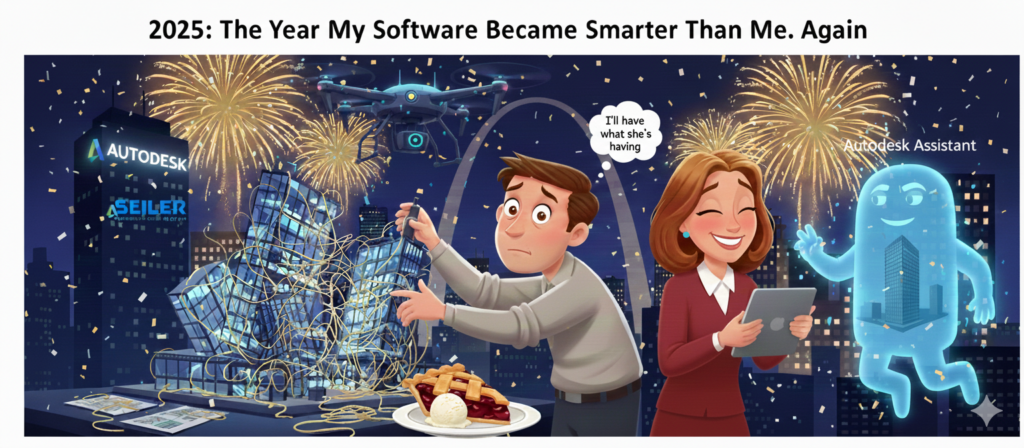
December 31, 2025 Location: The intersection of Design & Technology
It’s New Year’s Eve. The Auld Lang Syne is queuing up, the confetti is ready, and we’re looking back at a year that changed everything.
If you’re in AEC, you know the feeling. You’ve been waiting for technology to catch up to your imagination for a long time. And then, suddenly, in 2025, it happened. As Harry Burns might say: “When you realize you want to spend the rest of your career with a software ecosystem, you want the rest of your career to start as soon as possible.”
At Autodesk University 2025 in Nashville, the promise of the future stopped being a PowerPoint slide and started being a product. We moved from passive tools to active partners.
Here is a look at the definitive updates of 2025—and why, after all these years, we’re finally falling in love with our workflows.
1. The “I’ll Have What She’s Having” Moment: Neural CAD
The biggest headline of 2025? Agentic AI.
We aren’t just talking about chatbots anymore. We are talking about deep integration that automates 80–90% of the boring stuff. The new Autodesk Assistant isn’t just a helper; it’s a partner. It’s integrated across Revit, AutoCAD, and the Construction Cloud, acting less like a tool and more like a highly competent co-pilot.
Imagine asking Revit to calculate the window-to-wall ratio and then telling it to “replace all windows with larger units based on that data.” And it just… does it.
When architects saw the new “neural models” acting as auto-complete for complex geometry—generating 3D forms from simple sketches—a collective murmur went through the industry: “I’ll have what that software is having.”
2. Can Men and Women (and File Formats) Be Friends?
Harry insisted that men and women can’t be friends because the “sex part” always gets in the way. In our industry, file formats always got in the way.
But in 2025, Autodesk proved that different software can be friends.
This year, data finally broke out of its silos. With the new Data Exchange Connectors for Tekla, Rhino, and Inventor, we stopped moving heavy, monolithic files and started streaming granular data. The new Data Model for IFC (currently in beta) allows us to extract just the specific data we need without opening the entire heavy file.
Finally, the design data connects directly to construction workflows without the “awkward morning after” of file translation errors.
3. High Maintenance? No, Just Precise (Sustainability)
We all love Sally Albright, but she was… particular. “I’d like the pie heated, and I don’t want the ice cream on top, I want it on the side, and I’d like strawberry instead of vanilla if you have it, if not then no ice cream just whipped cream but only if it’s real…”
In 2025, we all became Sally regarding Sustainability. We don’t want carbon analysis “eventually.” We want it now, on the side, specifically calculated.
Autodesk was named one of Fast Company’s “Most Innovative Companies” this year because they gave us exactly that.
-
Speed: AI has slashed environmental simulation times by 99%.
-
Precision: The Total Carbon Analysis for Architects in Autodesk Forma lets you see the carbon impact of your choices while you are designing.
-
Choice: In the Autodesk Construction Cloud, you can now integrate with EC3 to pick materials based on embodied carbon during estimating.
We want the sustainable building, and we want it exactly the way we want it.
4. The Old Married Couples: Revit & AutoCAD
Revit and AutoCAD are the Jess and Marie of the software world—they’ve been together forever. But even old couples need to spice things up to keep the romance alive.
-
Revit 2025: If you’ve ever cried over site design, dry your eyes. The new Toposolids are here. No more triangulated mesh looks. We finally have real excavation tools. You can cut topography with floors and roofs and get precise volume calculations. It’s beautiful.
-
AutoCAD 2025: The old dog learned some incredible new tricks. The Smart Blocks feature uses AI to search your messy drawing, find geometry, and convert it into blocks automatically.
-
The Best Part: They updated Hatching. You can finally—finally—draw hatch boundaries after starting the command without needing a pre-existing closed shape. It’s the little things that make a marriage work.
The Outlook
As the ball drops on 2025, it’s clear the AEC industry has crossed a threshold. We aren’t just drawing lines anymore; we are collaborating with intelligent systems that understand what we want.
So, to Autodesk and the AEC community: I love that you are the last software I want to talk to before I go to sleep at night.

🎉 2026 AEC New Year’s Resolution Checklist: Becoming an Agentic Architect
This year, your resolution isn’t just about learning new features; it’s about changing how you think about design. These five resolutions will help you transition from being a user of software to a collaborator with intelligent systems.
| # | Resolution | The “Why” (Focusing on 2025 Updates) | How to Succeed |
| 1. | Master My Data, Not Just My Files. | The new Data Exchange Connectors and IFC Data Model mean files are dead; data streams are king. Your AI (Resolution #2) needs clean, granular data to work properly. Stop thinking in .rvt and start thinking in data points. |
Schedule a team workshop dedicated solely to information management standards (not modeling standards). Focus on organizing properties, not geometry. |
| 2. | Befriend the Agentic AI. | The Autodesk Assistant and Neural CAD features are designed to handle 80% of repetitive tasks. Your job is now to master the prompt (the instructions) rather than the click. | Spend 30 minutes a week testing the AI assistant with complex, multi-step instructions (e.g., “Find all windows with WWR < 15% and replace with Unit-Type-B.”). |
| 3. | Design with Carbon, Not Just Cost, in Mind. | The Forma Total Carbon Analysis and ACC’s EC3 integration make sustainability a real-time metric. Your designs must now satisfy 3 constraints: Time, Cost, and Carbon. | Integrate a simple carbon goal (e.g., “Reduce embodied carbon of primary structure by 10%”) into your first design phase on every project starting this quarter. |
| 4. | Ditch the Site Workarounds. | The new Revit 2025 Toposolids are a massive leap. Stop using stacked floors and complex massing for site work. Embrace the true excavation and smooth shading features. | Archive your old “site component families” and spend a day mastering the new Toposolid tools. Practice cutting complex shapes (like retaining walls or trenches) out of your site model. |
| 5. | Embrace the Construction Cloud for Handover. | The new ACC Handover Tool and Correspondence Tool solve the eternal headache of project close-out. Stop compiling PDFs and start delivering a searchable, data-rich digital twin. | Set a mandatory project rule: all submittals, RFIs, and project communication must live within the ACC Correspondence tool from day one to ensure a clean final package. |
🥂 A Final Thought for 2026
Remember Harry’s realization: “I came here tonight because when you realize you want to spend the rest of your life with somebody, you want the rest of your life to start right away.”
Your future in AEC starts now. By committing to these new, intelligent workflows, you’ll ensure that the rest of your career is smarter, faster, and more creative! We’re here for all of your questions and to assist you with creating your firm’s specific workflows!
Happy New Year, everyone. Here’s to building the future!

📚 Glossary of Future Tech (Hyperlinked for Learning)
| Term | Definition & Context (2025) | Link to Learn More |
| Agentic AI | AI systems (like the Autodesk Assistant) that can understand complex goals and execute multi-step tasks across different software platforms autonomously, moving beyond simple commands. | Agentic AI in AEC overview |
| Autodesk Construction Cloud (ACC) | The unified platform connecting design, planning, and construction workflows, receiving major updates like new Handover and Correspondence tools. | ACC official page |
| Data Exchange Connectors | Tools that allow users to share specific subsets of data (not entire files) between different software products (e.g., Revit, Rhino, Inventor), emphasizing true interoperability. | Autodesk Data Exchange ecosystem |
| EC3 | The Embodied Carbon in Construction Calculator. Used within the ACC environment to help users select materials with lower environmental impacts during the estimating phase. | Autodesk Embodied Carbon Analysis |
| IFC Data Model | A new approach to the open-standard IFC file format, allowing users to extract specific, granular data points rather than dealing with the entire heavy model file. | What is IFC Format |
| Neural CAD | A creative term for the deep integration of AI foundation models directly into CAD/BIM software, enabling AI to auto-complete geometry and optimize designs based on constraints. | Agentic AI/Neural CAD in AEC |
| Revit Toposolids | The new, geometry-rich site design element in Revit 2025 that replaces the old Topography Surface, enabling precise excavation and smoother visual representation. | Revit 2025 Toposolid improvements |
| Smart Blocks | An AutoCAD 2025 feature that uses AI to analyze existing drawing geometry and automatically convert repetitive shapes into reusable, standardized blocks, drastically speeding up cleanup. |

Leave A Comment