

Mission Briefing: When Cobra’s latest H.I.S.S. tank parade leaves the St. Louis headquarters in ruins, the Joes don’t just rebuild—they innovate. Join Snake Eyes, Scarlett, and the rest of the team as they deploy the Seiler Design Solutions workflow to construct “The Pit 2.0.” From navigating Missouri’s complex topography in Civil 3D and architecting blast-proof bunkers in Revit to maintaining a “Single Source of Truth” in the Autodesk Construction Cloud, this guide breaks down the high-stakes world of BIM collaboration.
Learn the silent art of link verification through the Desktop Connector and ensure your project data is as unbreakable as a ninja’s resolve. Because when it comes to rebuilding a fortress, knowing your workflow is half the battle!
To: All Joe Command Units
From: Classified HQ (BIM Division)
Subject: Site Reconstruction – St. Louis, MO
Before the first shovel hits the Mississippi mud, let’s be clear: the previous base didn’t just “fall.” It was “deconstructed” by a Cobra H.I.S.S. tank parade. We aren’t just rebuilding; we are deploying the Seiler Design Solutions initiative. We’re moving from analog blueprints to a high-fidelity Digital Twin. If Snake Eyes can communicate through silence, our data should be able to communicate through the Cloud.
The Who: The Silent Professional & The Loud Engineers
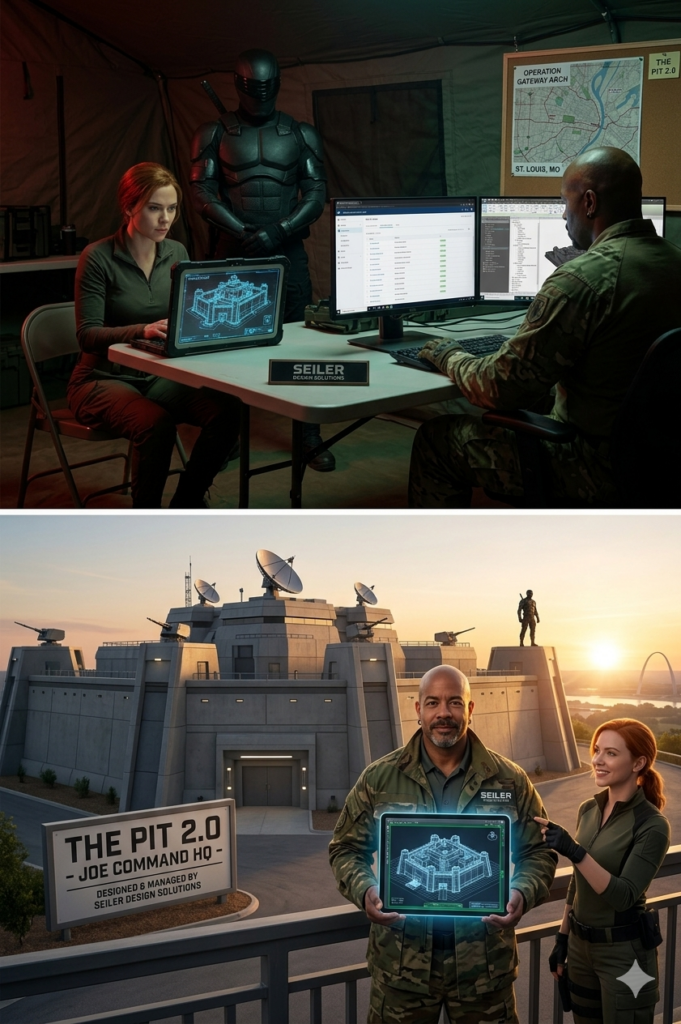
This isn’t a one-man job. Snake Eyes is overseeing site security (mostly by standing on rafters and looking intimidating), while Scarlett manages the data architecture. Roadblock is handling the heavy lifting—which, in this case, means managing the sheer file size of a fully rendered fortress.
The Why: Why St. Louis?
Aside from the great toasted ravioli, St. Louis provides a central tactical hub. But building near the Mississippi River means dealing with complex topography and flood plains. We can’t just “wing it” with a 2D CAD file. We need a coordinated, multi-disciplinary approach to ensure “The Pit 2.0” doesn’t become “The Puddle 2.0.”
The What: The BIM Arsenal
We are combining the three pillars of modern military-grade design supported by the Seiler Design Solutions workflow:
-
Autodesk Civil3D: For the St. Louis terrain and underground bunkers.
-
Autodesk Revit: For the hardened structure and internal tactical centers.
-
Autodesk Construction Cloud (ACC): Our “Single Source of Truth” so Duke doesn’t look at Revision A while Shipwreck is building Revision C.
1. Civil3D: Mastering the Mound City
Roadblock started in Civil3D. Because the fortress is embedded in the Missouri limestone, he’s modeling the excavation using complex Grading Groups.
-
The Technical Bit: We’re using a Shared Reference Point to ensure the site coordinates in Civil3D match the internal origin in Revit. If these are off by even an inch, the secret entrance might end up inside a local Busch Stadium dugout instead of the base.
-
The Humor: Gung-Ho tried to manually move the survey points because he “thought they looked better to the left.” He has since been banned from the workstation and sent to guard the parking lot.
2. Revit: Modeling the “Silent” Fortress
While the site is being graded, Scarlett is in Revit designing the superstructure. We’re talking parametric blast-proof doors and a mess hall optimized for maximum protein intake.
-
The Strategy: We’ve split the model into “Shell and Core” and “Tactical Interiors.” This keeps the file sizes manageable.
-
The Humor: Snake Eyes has requested that his training room be modeled with “Zero Sound Transmission” walls. At least, that’s what we think he requested; he just pointed at a mute button and then at a brick.
3. The Autodesk Cloud: No Joe Left Behind
By hosting our files on the Autodesk Construction Cloud (ACC), the team can collaborate in real-time. Whether Scarlett is at the Pentagon or Snake Eyes is on a covert op in the Ozarks, they can access the latest models.
-
Design Collaboration: We use “Consumed” models. Revit doesn’t just grab the live Civil3D file (that’s a recipe for chaos). We “Package” the site data and “Consume” it into the architectural space. This prevents a “Work in Progress” grading change from moving the floor out from under a Joe mid-briefing.
4. The Magic Link: Desktop Connector & Link Verification
This is the “Secret Sauce” of the Seiler Design Solutions workflow. The Desktop Connector is the bridge between your local PC and the Cloud. But even the best bridge can have a loose plank.
The Best Route to Verify Links: If your Revit model looks like a ghost town because the Civil3D links are missing, don’t blame Destro. Follow the protocol:
-
The Reference Explorer: This is your most powerful tool. Open the Desktop Connector, right-click the file, and select Reference Explorer. It provides a visual map of every Xref and Link. If a line is red, the link is broken.
-
Path Type Check: In Revit, check Manage > Manage Links. Ensure the “Saved Path” starts with
Autodesk Docs://. If it saysC:\Users\Roadblock\Documents, you’ve created a “Local Path” that no one else can see. That’s a dishonorable discharge. -
The “Pending Actions” Check: Before yelling at the IT department, check your Desktop Connector tray icon. If it’s stuck on “Pending,” your files are still in transit. Be patient—even data moves slower than a Sky Striker in a headwind.
The Final Debrief
Rebuilding a fortress in the heart of the Midwest requires more than just guts—it requires synchronized data. By using Civil3D for the land, Revit for the steel, and the Cloud to hold it all together, the Joes are ready for whatever Cobra throws next.
Stay synced, stay linked, and Yo Joe!
If you or your team need to discuss workflows between yourself, your teams, software and hardware, give us a call today!
Here are the official links to the specialized tools and heroes featured in todays Seiler Design Solutions mission:
The Autodesk BIM Arsenal
-
Autodesk Civil 3D: Used by Roadblock for precision site grading and tunneling through the Missouri limestone.
-
Autodesk Revit: Scarlett’s tool of choice for modeling the blast-proof superstructure and “Silent” training rooms.
-
Autodesk Construction Cloud (ACC): The “Single Source of Truth” that keeps the Joes synced from the field to the Pentagon.
-
Autodesk Desktop Connector: The critical bridge that ensures your local files and cloud data stay in formation.
The Real American Heroes – Knowing is half the battle!
-
G.I. Joe Official: The headquarters for all things Snake Eyes, Duke, and the rest of the team.


Leave A Comment